Attention Destroys Representation
In development. April 2026 revision.
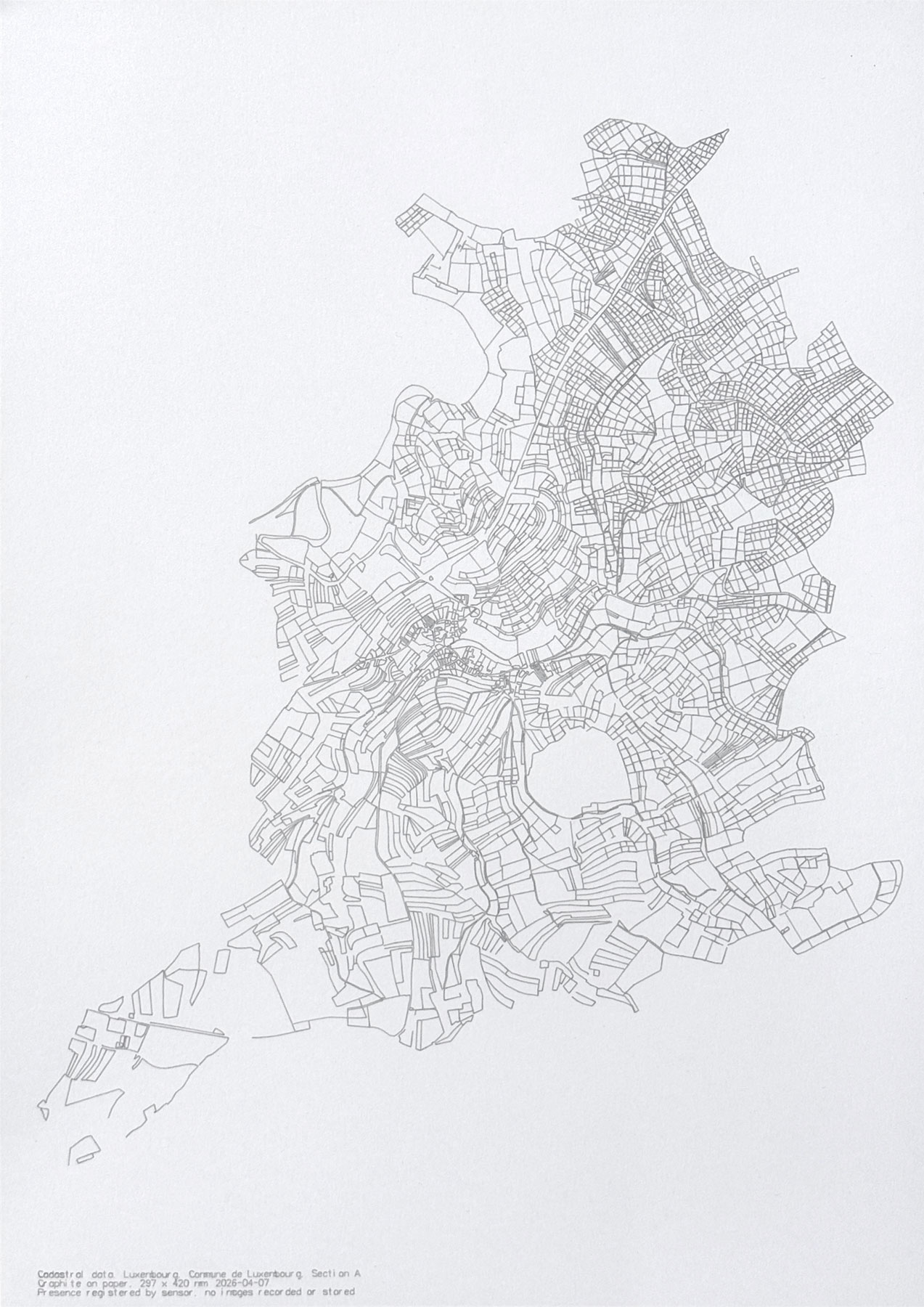
A pen plotter draws a property map on paper. The source material is cadastral data from the venue's own jurisdiction, centered on the venue's own location. Show the work in Luxembourg: it draws Luxembourg parcels. Show it in Basel: it draws Basel parcels. Every execution produces a different drawing from a different legal geography.
The drawing takes days. A microwave presence sensor registers how many people are in the room and where they stand. No camera. No images. No identity. The sensor detects bodies as radio-frequency perturbations, nothing more.
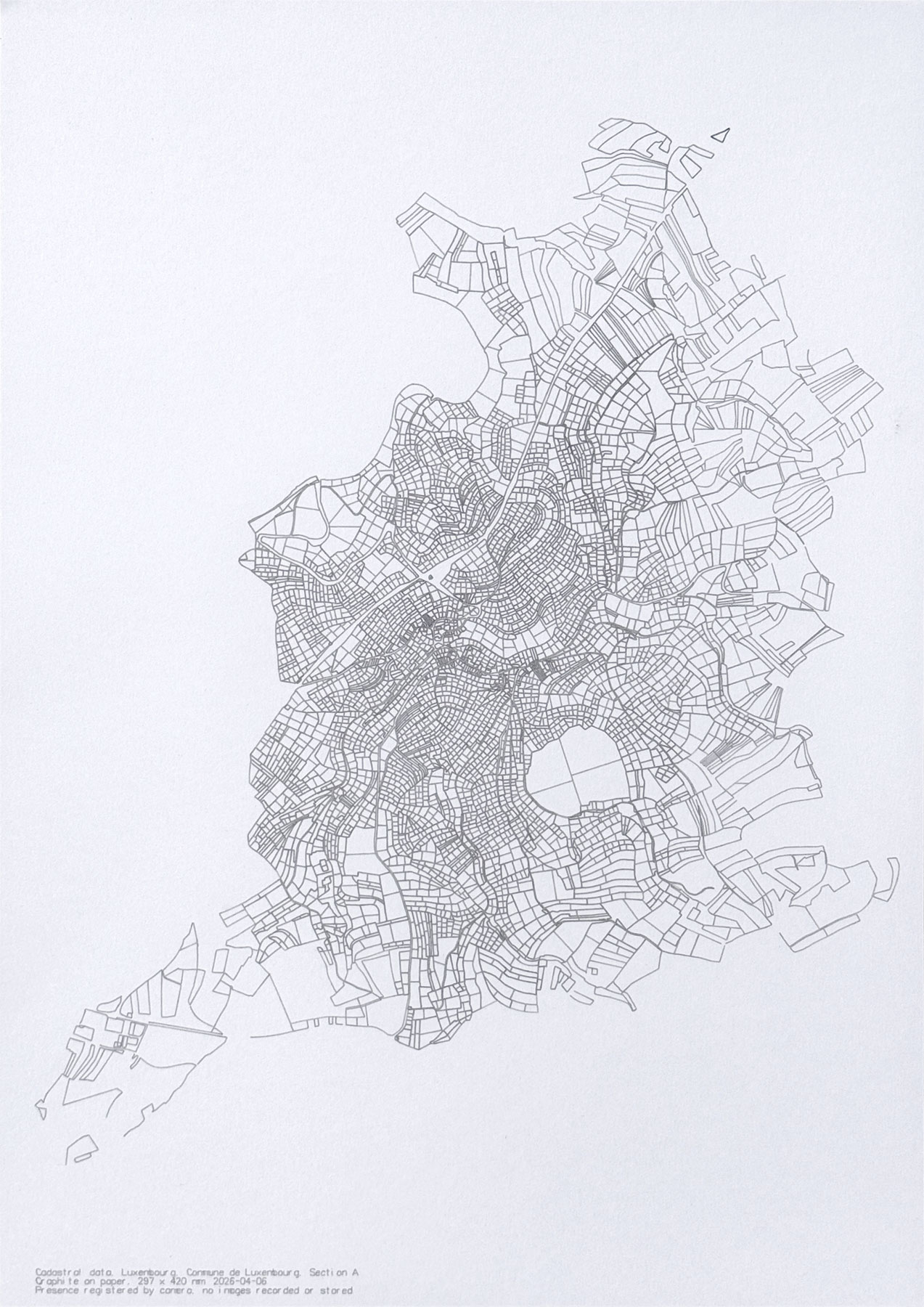
The cadastre does not arrive complete. The plotter begins with the longest boundary lines, which read as abstract geometry. As presence accumulates in a zone, shorter boundaries appear. The map becomes legible where people have lingered. Where nobody stands, the cadastre never fully forms.
Where presence continues to build, parcels begin subdividing. The cadastre's own logic of spatial division is applied in response to the one variable it was never designed to register: human density. Subdivisions follow cadastral convention (perpendicular to the longest edge, road frontage preserved). They read as administrative overload, not noise. The system fails in its own language.
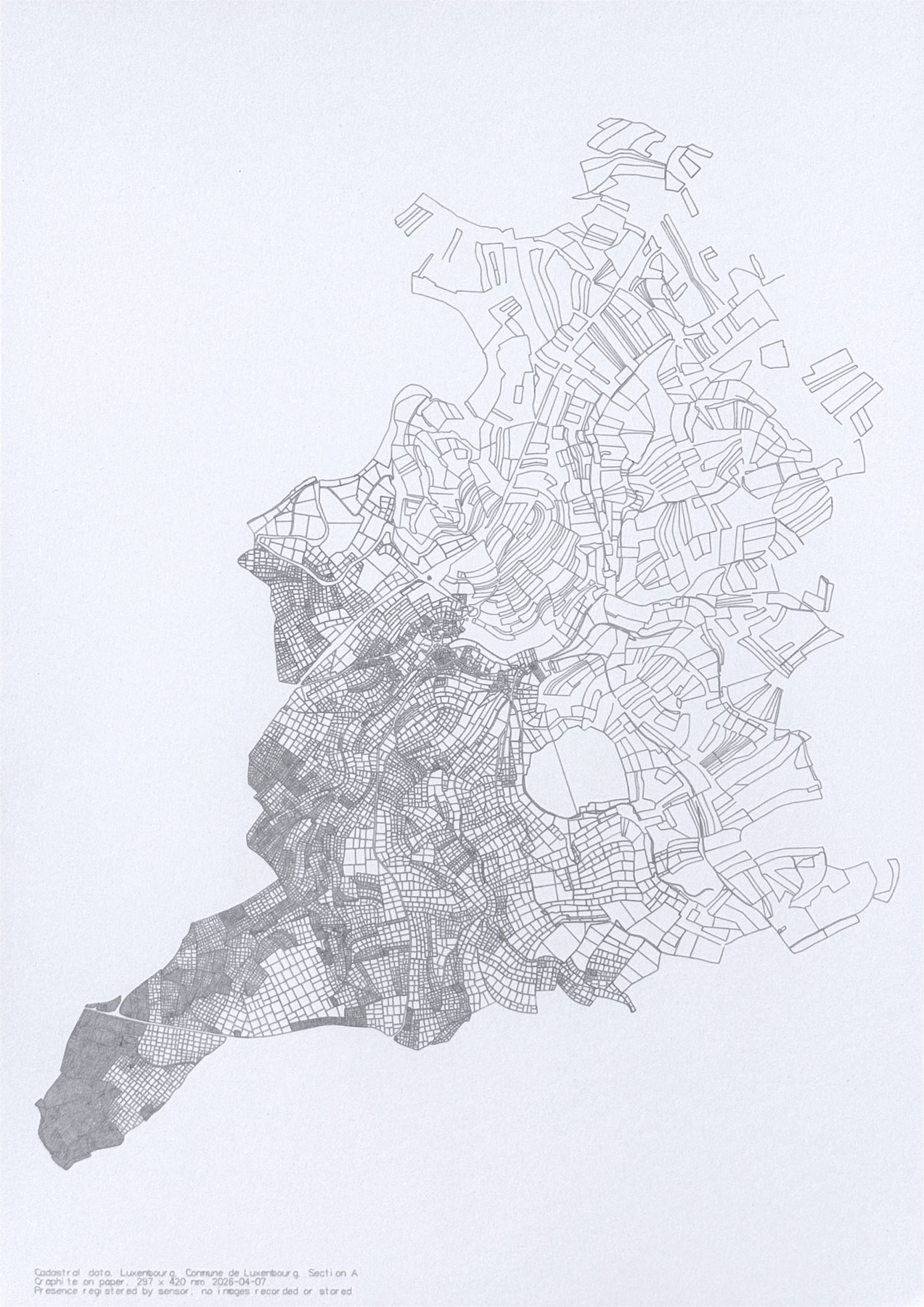
The result is a gradient across the paper. Blank where nobody stood. Abstract lines where few passed. A legible property map where people gathered. And past that, parcels fragmented into a density of boundary lines so tight the map collapses into illegibility. All produced by the same cause: collective presence.
The pencil holds a single stick of graphite. When the stick is spent, the plotter stops. No replenishment. The dead work remains on view: drawing, motionless plotter, the counter at zero. These are not remnants. They are the work in its final state. Early visitors consume what later visitors never see.
The system carries memory across installations. Each venue's cadastral space can only be consumed once. A return visit to the same institution starts where the previous exhibition ended, drawing from further out, from space the institution does not occupy. The institution becomes an expanding zone of cadastral fragmentation.
The registrar's notation replaces the artist statement:
"Cadastral data, [jurisdiction]. Graphite on paper. Presence registered by microwave sensor; no images recorded or stored."