Trust me, bro
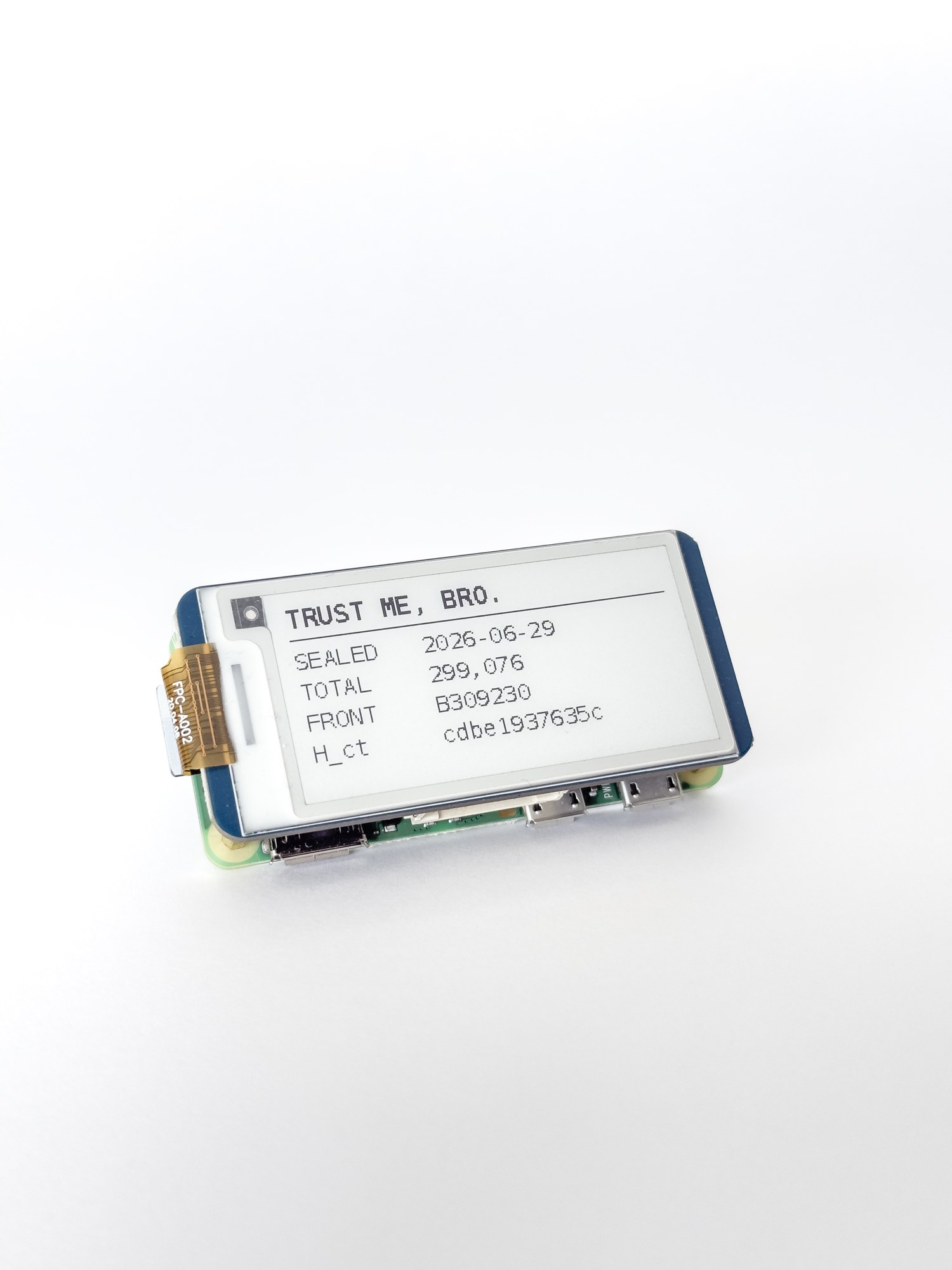
Sibling work to Public Record. In development.
A Raspberry Pi Zero 2W with an e-ink display. On its memory card, the full scraped database of Luxembourg's company register, encrypted with AES-256-GCM. The key was drawn once from /dev/urandom, used to encrypt, and shredded before the card was sealed. The ciphertext is materially present. There is no key, anywhere, to read it. Not mine.
The device is powered on a single time. A boot script reads a small cleartext metadata file, paints it onto the e-ink, and halts. The Pi is then unplugged. The e-ink holds its image without power. What it shows is only this: the title, the date of sealing, the total number of records inside, the last registration number reached, and the first characters of the ciphertext's hash. No company name, no address, no number from the register itself appears. The seal applies to the display as much as to the encryption.
Public Record draws the register into a form that is legible up close and unreadable at the scale of the page. This work holds the same data in a form that is real and unreadable by any means. The Business Register is public by law and unreachable by design: one lookup at a time, a puzzle before each search, a bulk-download button that returns an empty file. The sealed device performs the same property in a different register. The data is there. It cannot be reached.
Everything the device asserts can be checked but one thing. Anyone may pull the card and confirm the ciphertext's hash. Anyone may test sample records against the live register and confirm they are real. The method is open to inspection, and the hashes are timestamped against a public chain. That the key is gone cannot be proven to you; it is documented and signed, not proven. One point in the work is taken on trust. The title says so.
The Pi is bare. The processor, the card slot, the power connector stay in view. Once it has imprinted the display, it is a still computer: visible substrate, frozen screen, sealed contents.